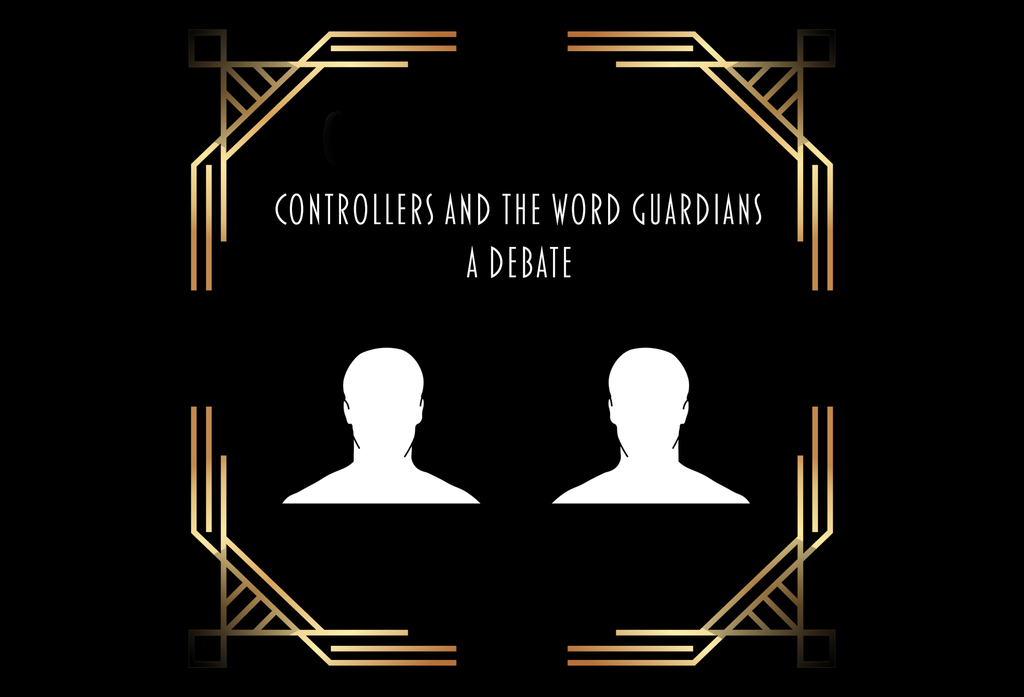
An imagined debate between two very different visions for the future, both for peace.
Two figures sat behind screens.
Their identities were deliberately concealed. Neither knew who sat on the other side, and the audience was given no clues.
One represented the Word Guardians, who defend the freedom of the imagination of readers.
The other represented the Controllers, who seek to control the minds of readers to achieve their goals.
They had been brought together to debate a deceptively simple question:
What does it take to create a better world?
I acted as facilitator. What followed was less a debate about whether peace and happiness are desirable, they both agreed on that. It was more a debate about whether those things could ever be genuine if they were imposed rather than freely chosen.
Freedom or Chaos?
The Word Guardians spoke first.
Freedom, they said, was fundamental.
Not simply freedom to act, but freedom of imagination, thought, words and actions. The ability to imagine something different, question what exists, disagree with others and choose one’s own path.
The Controllers immediately challenged that idea.
Freedom sounds wonderful, they argued, but what does it produce?
Conflicting opinions. Competing interests. Disagreement. Chaos.
If everyone is free to pursue their own vision, nothing gets done. No one wins. Society becomes divided.
So, I asked them:
Is conflict simply the price we must pay for freedom?
If freedom inevitably produces conflicting ideas and competing interests, is conflict simply the price we must pay, or is it evidence that freedom itself needs to be restrained?
The Word Guardians were unequivocal.
Freedom of thought is a fundamental right. Just as freedom of speech is protected in many democratic societies. The ability to think independently must also be protected.
The Controllers dismissed this as an airy-fairy ideal.
Thought, they argued, doesn’t exist in isolation. We are bombarded by influences, news, media, other people, experiences and ideas. Thoughts become influences, influences shape decisions, and decisions eventually become actions.
Why pretend that thoughts are somehow sacred when they are simply another force shaping the future?
The Word Guardians saw the argument differently.
They accused the Controllers of relying on a familiar operating model: control to achieve change.
The Controllers think in absolutes, they argued. They cannot tolerate variance, different thoughts, different actions, different outcomes.
The response came quickly:
“All you’re promoting is chaos.”
Who Decides When Freedom Has Gone Too Far?
That led to a more uncomfortable question.
“Should anyone ever have the power to decide when freedom has gone too far?”
The Word Guardians hoped that the many influences available to individuals, news, media, education, experience and the voices of others, could provide both hope and warning.
People could learn, change their minds, evolve.
But what other safeguards could there be?
The Controllers saw the problem immediately.
“Without safeguards, there is always chaos.”
And then came their challenge:
“What does freedom really mean? If the ultimate objectives are peace and harmony, why not simply go there directly?
Why take the uncertain route through unrestricted choice, disagreement and conflict?
Control the outcomes. Skip the middleman of freedom.”
What does it take to achieve a peaceful world?
The Controllers’ argument became increasingly compelling in its simplicity.
People are happy when they don’t have to make every decision themselves.
There are too many choices. Too many decisions. Too much uncertainty.
Why not deliver peace?
Why not create harmony?
Why not influence people until they agree with the majority?
A unified world, they argued, creates harmony.
Disagreement has to be resolved.
And if influence and control are necessary to convert the disbelievers into agreement with the masses, perhaps that is simply the price of achieving a peaceful society.
The Word Guardians disagreed.
What is peace without freedom?
If you haven’t been able to choose harmony for yourself, how do you know you would have chosen it?
And how do you know you would actually be happy with it?
Freedom, they argued, isn’t the guarantee of a happy outcome.
It is the right to make the choice.
The Controllers had a blunt response.
People are stupid. They can’t be trusted.
They pointed to history.
Wars. Conflicts. Disagreements.
Again and again, humanity had demonstrated its inability to live peacefully.
Why continue trusting people to make the right decisions when history appears to show that they repeatedly make the wrong ones?
The Word Guardians had an answer:
“Yes. There are disagreements. But that is precisely the power of freedom. Disagreement means people are thinking.
It means they are questioning.
It means they have the opportunity to challenge an idea rather than simply accept it.
And, perhaps most importantly, disagreement is a fundamental right.”
The Final question
At that point, the debate had moved beyond the question of whether peace was desirable.
Both sides wanted peace.
Both wanted a happier world.
Both believed they were working toward something better.
The fundamental difference was how they defined the path to get there.
So, I asked one final question:
“Suppose you could create the world you want. A world of peace, happiness and harmony, but achieving it required limiting people’s choices and guiding them toward a common way of thinking. Would you accept that world if you knew it would make the majority happy?
And if you wouldn’t, what are you prepared to sacrifice to preserve the freedom to choose?”
The Controllers didn’t hesitate.
Exactly.
A world where people are happy. A world without conflict. A world at peace.
“Give us the Nobel Peace Prize now.”
The Word Guardians disagreed.
You cannot limit people’s freedom and call the result peace.
That, they argued, was simply another absolute.
Peace has to be arrived at freely.
People need to decide what they are prepared to do for peace. They need to understand why they are doing it. And, crucially, they need to experience the consequences of their choices.
Because telling someone what they want, and telling them why they need, isn’t the same as allowing them to discover what they want for themselves.
Where do you stand?
Perhaps the most interesting thing about the debate is that neither side believes it is the villain.
The Controllers believe they are protecting humanity from itself.
Their question is simple:
If we can create a peaceful and happy world, why wouldn’t we?
The Word Guardians believe that the method matters just as much as the result.
A peaceful society isn’t necessarily a free society.
Their question is equally simple:
If someone else chooses your peace for you, is it really yours?
Perhaps the deepest disagreement isn’t about freedom at all.
It is about trust.
The Controllers don’t trust people to make the right choices.
The Word Guardians believe people must be trusted enough to make choices, including bad ones, and to learn from the consequences.
Because if you remove someone’s freedom to choose badly, you may reduce suffering.
But you also remove their freedom to choose well.
And perhaps that is the question the Controllers and the Word Guardians ultimately leave with us:
If you remove the freedom to choose, have you created a better world, or merely a more controlled one?
To learn how the battle plays out between the Word Guardians and the Controllers, buy Book 1, The Battle for the Peacekeepers today and start reading.
Follow us on social media for the latest news and updates…