Can Peace exist Without Freedom? A debate

An imagined debate between two very different visions for the future, both for peace.

Two figures sat behind screens.

Their identities were deliberately concealed. Neither knew who sat on the other side, and the audience was given no clues.

One represented the Word Guardians, who defend the freedom of the imagination of readers.

The other represented the Controllers, who seek to control the minds of readers to achieve their goals.

They had been brought together to debate a deceptively simple question:

What does it take to create a better world?

I acted as facilitator. What followed was less a debate about whether peace and happiness are desirable, they both agreed on that. It was more a debate about whether those things could ever be genuine if they were imposed rather than freely chosen.
Freedom or Chaos?

The Word Guardians spoke first.

Freedom, they said, was fundamental.

Not simply freedom to act, but freedom of imagination, thought, words and actions. The ability to imagine something different, question what exists, disagree with others and choose one’s own path.

The Controllers immediately challenged that idea.

Freedom sounds wonderful, they argued, but what does it produce?

Conflicting opinions. Competing interests. Disagreement. Chaos.

If everyone is free to pursue their own vision, nothing gets done. No one wins. Society becomes divided.

So, I asked them:

Is conflict simply the price we must pay for freedom?

If freedom inevitably produces conflicting ideas and competing interests, is conflict simply the price we must pay, or is it evidence that freedom itself needs to be restrained?

The Word Guardians were unequivocal.

Freedom of thought is a fundamental right. Just as freedom of speech is protected in many democratic societies. The ability to think independently must also be protected.

The Controllers dismissed this as an airy-fairy ideal.

Thought, they argued, doesn’t exist in isolation. We are bombarded by influences, news, media, other people, experiences and ideas. Thoughts become influences, influences shape decisions, and decisions eventually become actions.

Why pretend that thoughts are somehow sacred when they are simply another force shaping the future?

The Word Guardians saw the argument differently.

They accused the Controllers of relying on a familiar operating model: control to achieve change.

The Controllers think in absolutes, they argued. They cannot tolerate variance, different thoughts, different actions, different outcomes.

The response came quickly:

“All you’re promoting is chaos.”


Who Decides When Freedom Has Gone Too Far?

That led to a more uncomfortable question.

“Should anyone ever have the power to decide when freedom has gone too far?”

The Word Guardians hoped that the many influences available to individuals, news, media, education, experience and the voices of others, could provide both hope and warning.

People could learn, change their minds, evolve.

But what other safeguards could there be?

The Controllers saw the problem immediately.

“Without safeguards, there is always chaos.”

And then came their challenge:

“What does freedom really mean? If the ultimate objectives are peace and harmony, why not simply go there directly?

Why take the uncertain route through unrestricted choice, disagreement and conflict?

Control the outcomes. Skip the middleman of freedom.”


What does it take to achieve a peaceful world?

The Controllers’ argument became increasingly compelling in its simplicity.

People are happy when they don’t have to make every decision themselves.

There are too many choices. Too many decisions. Too much uncertainty.

Why not deliver peace?

Why not create harmony?

Why not influence people until they agree with the majority?

A unified world, they argued, creates harmony.

Disagreement has to be resolved.

And if influence and control are necessary to convert the disbelievers into agreement with the masses, perhaps that is simply the price of achieving a peaceful society.

The Word Guardians disagreed.

What is peace without freedom?

If you haven’t been able to choose harmony for yourself, how do you know you would have chosen it?

And how do you know you would actually be happy with it?

Freedom, they argued, isn’t the guarantee of a happy outcome.

It is the right to make the choice.

The Controllers had a blunt response.

People are stupid. They can’t be trusted.

They pointed to history.

Wars. Conflicts. Disagreements.

Again and again, humanity had demonstrated its inability to live peacefully.

Why continue trusting people to make the right decisions when history appears to show that they repeatedly make the wrong ones?

The Word Guardians had an answer:

“Yes. There are disagreements. But that is precisely the power of freedom. Disagreement means people are thinking.

It means they are questioning.

It means they have the opportunity to challenge an idea rather than simply accept it.

And, perhaps most importantly, disagreement is a fundamental right.”

The Final question

At that point, the debate had moved beyond the question of whether peace was desirable.

Both sides wanted peace.

Both wanted a happier world.

Both believed they were working toward something better.

The fundamental difference was how they defined the path to get there.

So, I asked one final question:

“Suppose you could create the world you want. A world of peace, happiness and harmony, but achieving it required limiting people’s choices and guiding them toward a common way of thinking. Would you accept that world if you knew it would make the majority happy?

And if you wouldn’t, what are you prepared to sacrifice to preserve the freedom to choose?”

The Controllers didn’t hesitate.

Exactly.

A world where people are happy. A world without conflict. A world at peace.

“Give us the Nobel Peace Prize now.”

The Word Guardians disagreed.

You cannot limit people’s freedom and call the result peace.

That, they argued, was simply another absolute.

Peace has to be arrived at freely.

People need to decide what they are prepared to do for peace. They need to understand why they are doing it. And, crucially, they need to experience the consequences of their choices.

Because telling someone what they want, and telling them why they need, isn’t the same as allowing them to discover what they want for themselves.

Where do you stand?

Perhaps the most interesting thing about the debate is that neither side believes it is the villain.

The Controllers believe they are protecting humanity from itself.

Their question is simple:

If we can create a peaceful and happy world, why wouldn’t we?

The Word Guardians believe that the method matters just as much as the result.

A peaceful society isn’t necessarily a free society.

Their question is equally simple:

If someone else chooses your peace for you, is it really yours?

Perhaps the deepest disagreement isn’t about freedom at all.

It is about trust.

The Controllers don’t trust people to make the right choices.

The Word Guardians believe people must be trusted enough to make choices, including bad ones, and to learn from the consequences.

Because if you remove someone’s freedom to choose badly, you may reduce suffering.

But you also remove their freedom to choose well.

And perhaps that is the question the Controllers and the Word Guardians ultimately leave with us:

If you remove the freedom to choose, have you created a better world, or merely a more controlled one?

To learn how the battle plays out between the Word Guardians and the Controllers, buy Book 1, The Battle for the Peacekeepers today and start reading.

Follow us on social media for the latest news and updates…
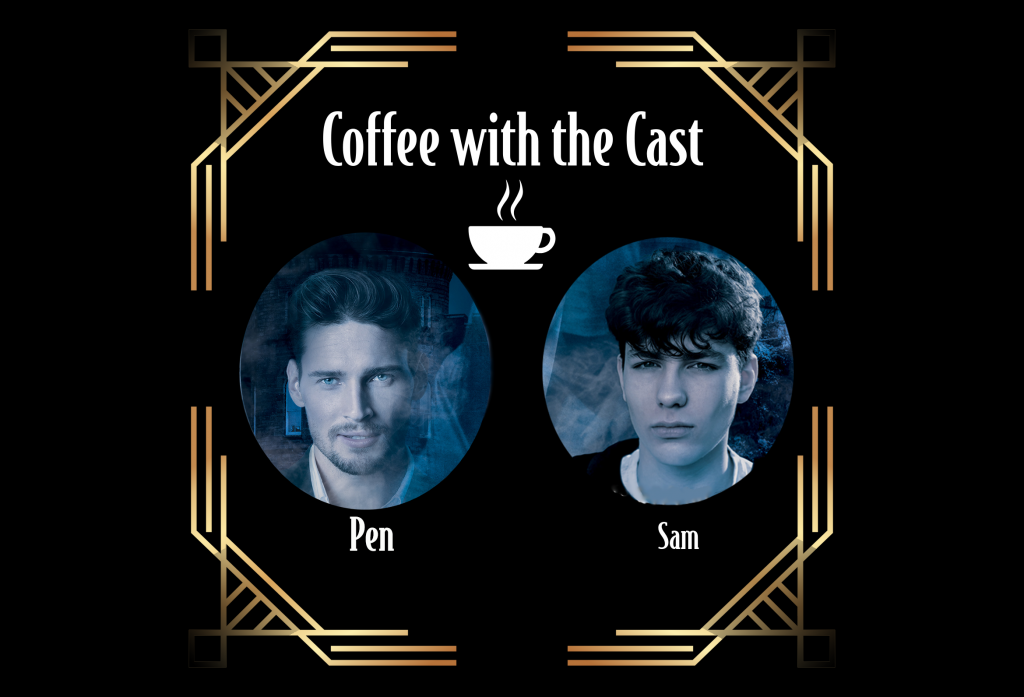
Caught in the mist – coffee with Penn and Sam

One of the unexpected highlights of The Shadow Readers was watching two very different characters being forced to work together. Penn, the enigmatic figure who always seems to know more than he lets on, and Sam, Yas’s fiercely loyal friend, spend much of the novel exchanging sarcastic remarks while somehow becoming an effective team.

I recently had the chance to have coffee with them and find out what they really think of each other. As it turns out, getting a straight answer from either of them is about as difficult as you’d expect…

Interviewer: Book 3, The Shadow Readers, is the first time readers really get to see the two of you working together. Given that neither of you would have chosen the other as a partner, what was your first impression of each other—and has it changed?

Sam looked at Penn.

“You go first, Dragon,” he teased.

Penn tilted his head in his trademark way before turning to me.

“I’ve worked with a number of the characters in the Word Guardians and sometimes wonder if I know what they’re really thinking. I do with Sam. He’s right there, with a quip, whether it’s helpful or not.”

Sam looked from Penn to me.

“A quip?” he asked.

“You don’t know what that is?” Penn replied. “Do you?”

“I’m ignoring that,” Sam said indignantly, looking away. “I know what that is. And I’ll say this about Penn. I feel in The Shadow Readers that I got to see a different side of him. Even more so in the upcoming The Story Thief. He’s really all about hon…”

Penn cut him off immediately. “I think you’ve answered the question. Let’s not give anything away.”


Interviewer: Readers have spent two books trying to work out whether Penn is a hero, a villain, or something in between. What’s the biggest misconception people have about the other one?

“You go first,” suggested Penn.

“Can I?” Sam asked. “I mean, I don’t want to give away anything.”

“Don’t worry. I’ll stop you if you do.”

Taking the playful dig in his stride, Sam turned back to me.

“I’m not sure about misconception, but I think everyone sees something different in Penn, and I think it’s intentional.”

Penn sat listening intently, one leg crossed over the other, thumb and finger resting thoughtfully on his chin.

“Go on,” he urged.

“I’m okay to say then, am I?” Sam asked with a grin.

“Oh, I’m curious to hear.”

“Well, he’s in disguise. You never really know who the real Penn is. He’s a businessman, a villain, he helps when it suits his agenda, and that’s really how we started to get to know each other better in The Shadow Readers.”

Penn nodded.

“Let’s just say I was shooting for misunderstood.”

“Quite,” Sam echoed, borrowing one of Penn’s favourite expressions.

Penn smiled before answering.

“I think the thing that’s most misunderstood by adversaries of Sam is that he’s the son of a policeman. That he lives his life literally and to the letter of the law. That’s not true for the Sam I know. He’s much deeper than his face suggests.”

“Wow,” Sam shot back playfully.


Interviewer: The two of you somehow manage to argue, joke and solve impossible problems at the same time. If you were dropped into a crisis with no plan whatsoever, which one of you would actually get you out of it, and which one would claim all the credit afterward?

“Hmm…” said Sam, looking across at Penn. “I think I know what you’ll say.”

Penn answered first.

“I have to give Sam some credit. I can’t be the one to come up with all the ideas.”

“All the ideas?” Sam laughed. “I’m the one who changes the plan when things don’t work out.”

“But they generally do,” Penn replied. “Remember the flying car?”

“The one that dove off a cliff and then crashed into a castle?” Sam asked incredulously.

“Well… that wasn’t my original idea, no. But it was ‘falling, with style.'”

“Falling with…” Sam scoffed.

After a moment, he added, “I think I’m the one who thinks about the problems just when they’re about to happen.”

“Yes,” Penn nodded. “So we have more time to react.”

Then, surprisingly, he added,

“But I’ll give you credit. You saved us in The Story Thief when we were climbing the castle walls.”

Sam looked back at me. “So, it’s teamwork then.”

“Sure, let’s call it that,” Penn agreed, only slightly reluctantly.


Interviewer: You’ve both spent time in worlds created by readers’ imaginations. What’s one place you’d happily visit again… and one you hope never to see again?

“I think Sam knows the place I like to visit,” Penn began.

Sam smiled.

“Misty lake, always at dusk?”

“Quite,” Penn agreed, smiling. “But don’t tell anyone. I’d like to remain misunderstood.”

“I think I do understand, though,” Sam replied.

Penn’s eyebrow rose in warning.

“I won’t say anything,” Sam added quickly. “I like the Penn I know. I know where he’s at. Understood by a few, misunderstood by many.”

Penn nodded.

“Let’s just say he’s complicated.”

“Okay then,” Sam laughed. “Is that your middle name?”

“Quite.”

Penn gestured towards me.

“You need to answer the question.”

“Oh, right.”

Sam thought for a moment.

“Any realm where I’m with Yas. And ideally one where we’re not in some type of danger. I love the Country Mansion Realm because I have memories of being there with my family.”

Penn nodded appreciatively.

“The moor. The sounds and the mist.”

“What is it with you and mist?” Sam asked.

“Mystery,” Penn replied, waving his hands theatrically.

“Anyway,” Sam continued, “I also like the Forest Realm that Yas first discovered in the Battle for the Peacekeepers. It’s a safe place and I can create new memories there with Yas.”

“Young love,” Penn teased.

“What about you, though? I’ve never asked that, actually,” Sam replied. “You must have had someone special?”

“Another story, for another time.” Penn cut off, gesturing to me for the next question.


Interviewer: Last question. Describe each other in just three words. No backhanded compliments.

“I remember this from last time,” Sam said. “And I like that it’s about each other here.”

He looked thoughtfully at Penn.

“Hmm… I’ll say mystery… layers… and hon…”

“There you go again,” Penn interrupted. “Where’d you get the layers from, anyway? I’m not an onion!”

“The mist you like so much,” Sam shot back.

“Hmm,” Penn acknowledged with a smile. “The thing you need to realise about mist is that it doesn’t hide the truth, it forces you to go closer to find it.”

“Deep,” replied Sam. “Layered.”

Penn paused, smiling. “Okay, my turn. For Sam I’d say… loyalty… commitment… and hon…”

“No,” Sam interrupted, laughing. “Let’s not give anything away now, shall we?”

Penn smiled.

“Joking aside, Sam was the logical choice for me to work with in The Shadow Readers, but how it turned out… I couldn’t have made a better one.”

“You feeling alright, Dragon?” Sam teased. “You only compliment when you’re ill.”

“I’m layered,” Penn replied, smiling.

“In mist,” Sam added, laughing. “Not an onion!”

“Quite,” Penn finished, punching Sam playfully on the arm as he looked back towards me.

There may be no pair in the Word Guardians series more unlikely than Penn and Sam. One hides behind mystery, the other wears his heart on his sleeve. One always seems to have a plan, while the other is usually the first to notice when that plan is going spectacularly wrong.

Yet somewhere between the sarcasm, the banter and the impossible adventures, they’ve become one of the series’ most enjoyable partnerships. If this interview proves anything, it’s that while readers may still be trying to work Penn out, one person already has a pretty good idea who he really is.

Sam just isn’t allowed to say it… yet.

To enjoy Sam and Penn’s camaraderie and how it develops, start with Book 1 today.

Follow us on social media for the latest news and updates…